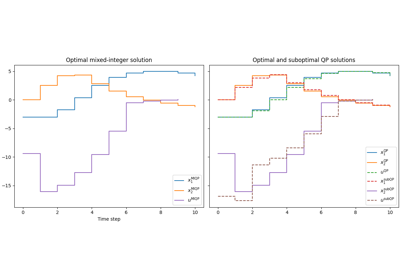
csnlp.wrappers.PwaMpc#
- class csnlp.wrappers.PwaMpc(*args, **kwargs)[source]#
Bases:
Mpc[SymType]MPC controller for piecewise affine (PWA) systems. A PWA system is characterized by linear dynamics that switch between different regions of the state-action space. In mathematical terms, given a PWA system with \(s\) regions, the dynamics are
\[\begin{split}x_+ = \begin{cases} A_1 x + B_1 u + c_1 & \text{if } S_1 x + R_1 u \leq T_1 \\ & \vdots \\ A_i x + B_i u + c_i & \text{if } S_i x + R_i u \leq T_i \\ & \vdots \\ A_s x + B_s u + c_s & \text{if } S_s x + R_s u \leq T_s \end{cases}\end{split}\]This MPC controller class can then handle two different types of specifications for the dynamics.
affine time-varying dynamics: the MPC controller can be considered as a linear MPC controller with time-varying dynamics, in which case the dynamics must be defined via the
set_affine_time_varying_dynamicsmethod. Then, prior to solving the optimization problem, the sequence of regions to be active at each time-step needs to be set viaset_switching_sequenceby the user/externally.optimzing also the sequence: alternatively, the sequence of PWA regions can be optimized over, in which case the dynamics must be defined via the
set_pwa_dynamicsmethod. Following [2], the PWA dynamics are converted to mixed-logical dynamical form, and the ensuing MPC optimization becomes a mixed-integer optimization problem. This is done under the hood via theset_pwa_dynamicsmethod. See also [3] for further details.
- Parameters:
- nlpNlp
NLP scheme to be wrapped
- prediction_horizonint
A positive integer for the prediction horizon of the MPC controller.
- control_horizonint, optional
A positive integer for the control horizon of the MPC controller. If not given, it is set equal to the control horizon.
- input_spacingint, optional
Spacing between independent input actions. This argument allows to reduce the number of free actions along the control horizon by allowing only the first action every
nto be free, and the followingn-1to be fixed equal to that action (wherenis given byinput_spacing). By default, no spacing is allowed, i.e.,1.- shooting‘single’ or ‘multi’, optional
Type of approach in the direct shooting for parametrizing the control trajectory. See Section 8.5 in [6]. By default, direct shooting is used.
- Raises:
- ValueError
Raises if the shooting method is invalid; or if any of the horizons are invalid; or if the number of scenarios is not a positive integer.
Methods
action(name[, size, discrete, lb, ub])Adds a control action variable to the MPC controller along the whole control horizon.
constraint(name, lhs, op, rhs[, soft, simplify])See
csnlp.Nlp.constraint.disturbance(name[, size])Adds a disturbance parameter to the MPC controller along the whole prediction horizon.
Returns the optimal switching sequence of regions for the state trajectory along the prediction horizon, which can be extracted from the solution of the corresponding mixed-integer optimization MPC problem (i.e., when the dynamics are set via
set_pwa_dynamics, which allows to optimize over the sequence as well, though more computationally expensive).is_wrapped(wrapper_type)Gets whether the NLP instance is wrapped or not by the given wrapper type.
set_affine_dynamics(A, B[, D, c, ...])Sets affine dynamics as the controller's prediction model and creates the corresponding dynamics constraints.
set_affine_time_varying_dynamics(pwa_system)Sets affine time-varying dynamics as the controller's prediction model and creates the corresponding dynamics constraints.
set_nonlinear_dynamics(F[, parallelization, ...])Sets the nonlinear dynamics of the controller's prediction model and creates the corresponding dynamics constraints.
set_pwa_dynamics(pwa_system, D, E[, ...])Sets the piecewise affine dynamics of the system for the MPC controller, creating auxiliary variables and constraints to handle the PWA switching.
set_switching_sequence(sequence)Sets the sequence of regions to be active at each time step along the MPC prediction horizon.
solve([pars, vals0])state(name[, size, discrete, lb, ub, ...])Adds a state variable to the MPC controller along the whole prediction horizon.
validate_pwa_dimensions(pwa_system)Validates that the dimensions are correct for all matrices in the passed PWA system.
Attributes
Gets the control actions of the MPC controller.
Gets the expanded control actions of the MPC controller.
Gets the control horizon of the MPC controller.
Gets the disturbance parameters of the MPC controller.
Gets the first (along the prediction horizon) actions of the controller.
Gets the first (along the prediction horizon) states of the controller.
Gets the initial states (parameters) of the MPC controller.
Gets the number of actions of the MPC controller.
Gets the number of disturbances in the MPC controller.
Gets the number of states of the MPC controller.
Gets the number of slacks of the MPC controller.
Gets the prediction horizon of the MPC controller.
Gets the slack variables of the MPC controller.
Gets the states of the MPC controller.
'Returns the original NLP of the wrapper.
- action(name, size=1, discrete=False, lb=-inf, ub=inf)#
Adds a control action variable to the MPC controller along the whole control horizon. Automatically expands this action to be of the same length of the prediction horizon by padding with the final action.
- Parameters:
- namestr
Name of the control action.
- sizeint, optional
Size of the control action (assumed to be a vector). Defaults to
1.- discretebool, optional
Flag indicating if the action is discrete. Defaults to
False.- lbarray_like, casadi.DM, optional
Hard lower bound of the control action, by default
-np.inf.- ubarray_like, casadi.DM, optional
Hard upper bound of the control action, by default
+np.inf.
- Returns:
- actioncasadi.SX or MX
The control action symbolic variable.
- action_expandedcasadi.SX or MX
The same control action variable, but expanded to the same length of the prediction horizon.
- Return type:
- property actions_expanded: dict[str, SymType]#
Gets the expanded control actions of the MPC controller.
- constraint(name, lhs, op, rhs, soft=False, simplify=True)#
See
csnlp.Nlp.constraint.
- disturbance(name, size=1)#
Adds a disturbance parameter to the MPC controller along the whole prediction horizon.
- Parameters:
- namestr
Name of the disturbance.
- sizeint, optional
Size of the disturbance (assumed to be a vector). Defaults to
1.
- Returns:
- casadi.SX or MX
The symbol for the new disturbance in the MPC controller.
- Return type:
TypeVar(SymType,SX,MX)
- property first_actions: dict[str, SymType]#
Gets the first (along the prediction horizon) actions of the controller.
- property first_states: dict[str, SymType]#
Gets the first (along the prediction horizon) states of the controller.
- static get_optimal_switching_sequence(sol)[source]#
Returns the optimal switching sequence of regions for the state trajectory along the prediction horizon, which can be extracted from the solution of the corresponding mixed-integer optimization MPC problem (i.e., when the dynamics are set via
set_pwa_dynamics, which allows to optimize over the sequence as well, though more computationally expensive).- Parameters:
- solSolution
An optimal solution of the mixed-integer PWA MPC problem.
- Returns:
- array of ints
An array of integers representing the indices of the regions that active at each time step along the prediction horizon, i.e., the k-th entry of this array represents the index of the region the predicted state is in at time step
k.
- Raises:
- KeyError
Raises if the solution does not contain the variable
delta, e.g., the solution was not obtained from a mixed-integer optimization problem, or the dynamics were not set viaset_pwa_dynamics.
- Return type:
- property initial_states: dict[str, SymType]#
Gets the initial states (parameters) of the MPC controller.
- is_wrapped(wrapper_type)#
Gets whether the NLP instance is wrapped or not by the given wrapper type.
- Parameters:
- wrapper_typetype of Wrapper
Type of wrapper to check if the NLP is wrapped with.
- Returns:
- bool
Trueif wrapped by an instance ofwrapper_type;False, otherwise.
- Return type:
- set_affine_dynamics(A, B, D=None, c=None, parallelization='thread', max_num_threads=None)#
Sets affine dynamics as the controller’s prediction model and creates the corresponding dynamics constraints. The dynamics are in the affine form
\[x_+ = A x + B u + D w + c,\]where \(x_+\) is the next state, \(x\) is the current state, \(u\) is the control action, \(w\) is the disturbance, and \(c\) is a constant term.
- Parameters:
- Asymbolic or numerical array
The state matrix \(A\) in the dynamics equation. Can also be sparse.
- Bsymbolic or numerical array
The action matrix \(B\) in the dynamics equation. Can also be sparse.
- Dsymbolic or numerical array, optional
The disturbance matrix \(D\) in the dynamics equation. Must be
Noneif no disturbances were provided via thedisturbancemethod. Can also be sparse.- csymbolic or numerical array, optional
The constant term \(c\) in the dynamics equation. By default,
None. If not provided, the dynamics become linear instead of affine.- parallelization“serial”, “unroll”, “inline”, “thread”, “openmp”
The type of parallelization to use (see
casadi.Function.map) when applying the dynamics along the horizon in multiple shooting. By default,"thread"is selected.- max_num_threadsint, optional
Maximum number of threads to use in parallelization (if in multiple shooting). See
casadi.Function.mapfor more information. By default, set equal to the prediction horizon.
- Returns:
- Optional 4-tuple of symbolic or numerical arrays
In multiple shooting, returns a tuple of
None. In single shooting, returns the matrices \(F, G, H, L\) that parametrize the dynamics. See, e.g., [5].
- Raises:
- RuntimeError
Raises if the dynamics were already set.
- ValueError
Raises if any of the matrices have the wrong shape; or if D was not provided but disturbances were set; or if D was provided but there are no disturbances set.
- set_affine_time_varying_dynamics(pwa_system)[source]#
Sets affine time-varying dynamics as the controller’s prediction model and creates the corresponding dynamics constraints. The dynamics in the affine time-varying form are described as
\[x_{k+1} = A_k x_k + B_k u_k + c_k.\]where \(x_k\) and \(x_{k+1}\) are the current and next state, \(u_k\) is the control action, \(w_k\) is the disturbance, and \(A_k, B_k, c_k\) are the constant matrices of the region to be visited by the state trajectory at time step k. By setting the dynamics with this method, the user can then specify the switching sequence of regions to be active at each time step along the prediction horizon via
set_switching_sequence, and solve a much simpler optimization problem, as the sequence is fixed. Instead, ifset_pwa_dynamicsis used, the sequence of regions is optimized over via a (usually expensive) mixed-integer optimization problem.- Parameters:
- pwa_systemsequence of PwaRegion
A sequence of
PwaRegionobjects, where the i-th object contains the matrices defining the i-th region of the PWA system.
- Returns:
- Optional 3-tuple of symbolic or numerical arrays
In multiple shooting, returns a tuple of
None. In single shooting, returns the matrices \(F, G, L\) that parametrize the dynamics. See, e.g., [5].
- Raises:
- RuntimeError
Raises if the dynamics were already set.
- ValueError
Raises if the dimensions of any matrix in any region do not match the expected shape.
- set_nonlinear_dynamics(F, parallelization='thread', max_num_threads_or_unrolling_base=None)#
Sets the nonlinear dynamics of the controller’s prediction model and creates the corresponding dynamics constraints.
- Parameters:
- Fcasadi.Function or callable
A CasADi function of the form \(x_+ = F(x,u)\) or \(x+ = F(x,u,d)\), where \(x,u,d\) are the state, action, and disturbance respectively, \(F\) is a generic nonlinear function and \(x_+\) is the next state.
- parallelization“serial”, “unroll”, “inline”, “thread”, “openmp”
The type of parallelization to use (see
casadi.Function.map) when applying the dynamics along the horizon in multiple shooting. By default,"thread"is selected.- max_num_threads_or_unrolling_baseint, optional
Maximum number of threads to use in parallelization (if in multiple shooting), or the base for unrolling (if in single shooting). See
casadi.Function.mapandcasadi.Function.mapaccumfor more information, respectively. By default, set equal to the prediction horizon.
- Raises:
- ValueError
Raises if the dynamics do not accept 2 or 3 input arguments.
- RuntimeError
Raises if the dynamics have been already set; or if the function
Fdoes not accept the expected input sizes.
- Return type:
- set_pwa_dynamics(pwa_system, D, E, clp_opts=None, parallelization='thread', max_num_threads=None)[source]#
Sets the piecewise affine dynamics of the system for the MPC controller, creating auxiliary variables and constraints to handle the PWA switching. In order to perform the conversion of the PWA dynamics to mixed-logical dynamical form, the method solves a series of linear programmes via the
CLPsolver. Parallelization can also be enabled to speed up the process.- Parameters:
- pwa_systemcollection of PwaRegion
A collection of
PwaRegionobjects, where the i-th object contains the matrices defining the i-th region of the PWA system.- Darray or casadi.DM of shape (n_ineq, ns + na)
The (possibly sparse) matrix
Ddefining the polytopic constraints on the state-action space \(D [x^\top, u^\top]^\top \leq E\), wherensandnaare the numbers of states and actions in the MPC problem, respectively.- Earray of shape (n_ineq,)
The matrix
Edefining the polytopic constraints on the state-action space \(D [x^\top, u^\top]^\top \leq E\).- clp_optsdict, optional
Options for the CLP solver. Defaults to
None.- parallelization“serial”, “unroll”, “inline”, “thread”, “openmp”
The type of parallelization to use (see
casadi.Function.map) when solving the linear programmes. By default,"thread"is selected.- max_num_threadsint, optional
Maximum number of threads to use in parallelization; if
None, the number of threads is equal to the number of regions in the system.
- Raises:
- RuntimeError
Raises if the dynamics were already set, or if lower and upper bounds on the states and/or actions are set.
- ValueError
Raises if the dimensions of any matrix in any region do not match the expected shape.
- Return type:
Notes
When multiple states and/or control inputs are defined, these are concatenated into the single vectors \(x\) and \(u\), respectively. Also, this function will raise an error if lower and upper bounds on any state or action are set. This is because these bounds should be instead specified via the matrices
DandE. Moreover, this function only uses these matrices for internal computations, so the user should take care to impose the constraints \(D [x^\top, u^\top]^\top \leq E\) in the optimization problem, as well as any other, via theconstraintmethod.
- set_switching_sequence(sequence)[source]#
Sets the sequence of regions to be active at each time step along the MPC prediction horizon. Then, when solved, the MPC optimization will only optimze over the action and state trajectories, while enforcing the sequence of regions visited by the states to be the one provided here.
- Parameters:
- sequencecollection of int
A collection of integers representing the indices of the regions to be active at each time step along the prediction horizon, i.e., the k-th entry of this collection represents the index of the region the state must be at time step
k.
- Raises:
- ValueError
Raises if dynamics have not been set via
set_affine_time_varying_dynamics; if the sequence is not the same length as the prediction horizon; if the sequence does not contain integers; if the sequence contains integers that exceed the number of PWA regions specified viaset_affine_time_varying_dynamics.
- Return type:
Notes
For internal validation purposes, please call first
set_affine_time_varying_dynamicsand only then call this method.
- state(name, size=1, discrete=False, lb=-inf, ub=inf, bound_initial=True, bound_terminal=True)#
Adds a state variable to the MPC controller along the whole prediction horizon. Automatically creates the constraint on the initial conditions for this state.
- Parameters:
- namestr
Name of the state.
- sizeint
Size of the state (assumed to be a vector).
- discretebool, optional
Flag indicating if the state is discrete. Defaults to
False.- lbarray_like, casadi.DM, optional
Hard lower bound of the state, by default
-np.inf.- ubarray_like, casadi.DM, optional
Hard upper bound of the state, by default
+np.inf.- bound_initialbool, optional
If
False, then the upper and lower bounds on the initial state are not imposed, i.e., set to+/- np.inf(since the initial state is constrained to be equal to the current state of the system, it is sometimes advantageous to remove its bounds). By defaultTrue.- bound_terminalbool, optional
Same as above, but for the terminal state. By default
True.
- Returns:
- statecasadi.SX or MX or None
The state symbolic variable. If
shooting=single, thenNoneis returned since the state will only be available once the dynamics are set.- initial statecasadi.SX or MX
The initial state symbolic parameter.
- Raises:
- ValueError
Raises if there exists already a state with the same name.
- RuntimeError
Raises in single shooting if lower or upper bounds have been specified, since these can only be set after the dynamics have been set via the
constraintmethod.
- Return type:
tuple[Optional[TypeVar(SymType,SX,MX)],TypeVar(SymType,SX,MX)]
- tva_dynamics_name = 'tva_dyn'#